AI Agents for Freight Brokers: The Complete 2026 Guide
Monday, 20 Apr 2026
|
AI Agents for Freight Brokers: The Complete 2026 Guide
By Sanjay Parihar, CEO at Debales AI · Last updated April 20, 2026
Quick answer: AI agents for freight brokers are software workers that read carrier emails, generate quotes, send check-calls, parse rate confirmations, and resolve routine exceptions without human prompting. In 2026, production deployments at mid-size brokerages automate 80%+ of inbound carrier emails, cut quote response from 47 minutes to under 5, and pay back in 60 to 120 days. The field is dominated by four vendors: Parade (capacity), HappyRobot (voice), Augment (operator copilot), and Debales (email + multi-agent). Buying criteria that matter: TMS integration depth, email volume handled, and whether the agent can act without human review by week 6.
For most of the last decade, "AI in freight brokerage" meant a load-matching score. A number next to a carrier name. Useful, incremental, not transformative.
2026 looks different. Agents now do the work. They read the inbound email from a carrier, check the TMS for the load, reply with a rate, update the load record, and schedule the follow-up. They sit in the inbox, in the phone queue, in the TMS. They measure themselves by the number of loads they cleared without needing a human.
This guide is the full picture. What AI agents actually do inside a brokerage, how they're different from chatbots, the five use cases that drive real ROI, how to evaluate vendors, what TMS integration looks like in practice, and what 2026 brokerage ops will look like if you deploy right.
What is an AI agent for a freight broker?
An AI agent is a software worker that can take action on its own. Not a chatbot that answers a question. Not a workflow that triggers on a rule. An agent:
- Reads structured and unstructured input (emails, PDFs, voice, TMS records)
- Reasons about what the right next step is
- Acts in the real world (sends emails, updates the TMS, triggers calls)
- Measures its own outcome and adjusts
In a brokerage context, that means the agent reads an inbound "Can you cover LA to Dallas, Thursday, dry van?" email, checks your carrier base in McLeod, finds three matches, ranks them by acceptance probability, drafts the cover email to each, sends the top pick, writes the interaction to the TMS, and flags the shipper back with an estimated cover time. All before a human looks at the thread.
The shift is from workflow automation (if this, then that) to outcome automation (here's the email, go get this covered). You're not coding rules any more. You're giving the agent a goal and a set of guardrails.
The 5 core agent use cases driving ROI in 2026
Not every vendor does all five. Most do one or two well.
1. Email agent (inbound)
Reads every carrier and shipper email, extracts intent, responds. This is the biggest single line item because 30–45% of a dispatcher's day goes to email. A good email agent handles rate requests, capacity inquiries, check-call responses, document requests, and routine exceptions. It escalates what it can't.
Real deployment numbers: 80%+ auto-response rate by week 6, average response time under 90 seconds, and human operators reassigned from inbox triage to carrier development.
2. Quote agent
Reads the quote request, pulls live rates from your data sources, checks capacity, drafts the quote, sends it. The C.H. Robinson benchmark is a 4-minute quote cycle versus the industry 47-minute average. Automated quoting narrows that gap for brokers of any size.
The ROI isn't just labor. A 22% lift in quote win rate at 300 inbound quote requests per week at $380 gross margin is ~$237K in annualized gross margin. Before headcount change.
3. Check-call agent
Outbound calls, emails, or texts to carriers asking for ETA and status. Automated check-calls reduce operator load by 25–40% in most brokerages and improve customer transparency. Voice-first vendors (HappyRobot, Parade's CoDriver) lead here. Email-first patterns are faster to deploy and integrate cleanly with carrier inbox behavior.
4. Rate confirmation parser
Reads the inbound rate con PDF or email, extracts all 30+ fields, writes them to the TMS, kicks off document routing. Cuts back-office time per load from ~12 minutes to under 60 seconds. This is the highest-accuracy use case — 95%+ field extraction is table stakes in 2026.
5. Exception management agent
Detects dwell events, late pickups, rejected loads, OS&D claims. Drafts the outreach to the carrier, customer, or internal team. Opens a ticket. Tracks resolution. Typical deployments cut mean-time-to-resolution on exceptions by 30%+ and reduce escalations per load by half.
How AI agents are different from freight chatbots
This trips up buyers who saw a chatbot demo in 2022 and walked away skeptical.
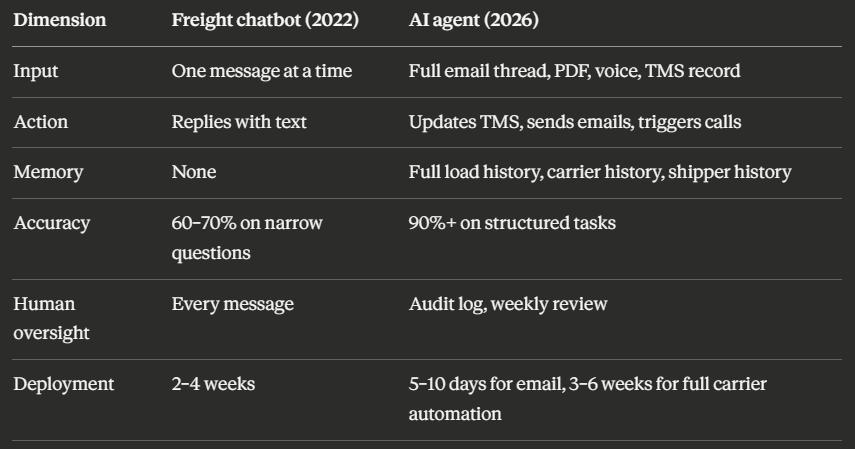
The difference is architectural, not incremental. Buyers shopping on "does it have AI" will buy a chatbot. Buyers shopping on "what outcomes does it own" will buy an agent.
Buying criteria that separate the good vendors from the slide decks
Six filters, in order of how often they become post-sale regrets.
1. TMS integration depth. If the agent can't read and write to your TMS cleanly (McLeod, Alvys, Tai, Turvo, Rose Rocket, Descartes Aljex), it runs as a parallel tool. Payback period doubles. Ask to see the integration live before signing.
2. Email volume handled at launch. Vendors who quote you "gradual rollout" usually mean "our system can't handle your volume on day 1." Ask for the week-1 and week-6 target coverage explicitly. Anything below 40% in week 1 is a red flag.
3. Audit log and human oversight. Every agent message, every TMS write, every decision should be reviewable. If you can't pull a CSV of the last 1,000 agent actions in 30 seconds, you can't defend it to a shipper or a broker-carrier dispute.
4. Time to first value. Email agent should be drafting replies in the sandbox within the first week. Full production in 5–10 business days. If the vendor's onboarding is 8 weeks, the agent isn't really ready.
5. Pricing model. Per-load pricing aligns incentives. Per-seat pricing incentivizes the vendor to lock you into headcount. Per-message pricing punishes you for scaling. The healthiest model is a flat platform fee plus per-load overage.
6. Ownership of customer data. Your carrier base and rate history is the most valuable asset you have. The contract should be explicit about data portability and whether the vendor trains its models on your data for other customers. Debales doesn't. Most don't. Get it in writing.
TMS integration: what it actually looks like
For McLeod LoadMaster, Alvys, Tai TMS, Turvo, Rose Rocket, and Descartes Aljex, modern AI agents integrate via a mix of API, webhook, and direct DB reads where permitted. Three patterns:
- Read-only first: Agent reads load, carrier, and customer records. Drafts actions. Human clicks approve. This is week 1–2.
- Writeback on green-light tasks: Agent writes rate con extractions, check-call outcomes, and email replies. Human reviews weekly audit. Week 3–6.
- Full autonomy on trained categories: Agent handles any email category where it's hit 95%+ accuracy for 30 days. Human reviews exceptions only. Week 6+.
Brokerages that get to pattern 3 by day 90 see the full ROI band. Brokerages that stay in pattern 1 see a third of it.
Real ROI: what mid-size brokerages are seeing
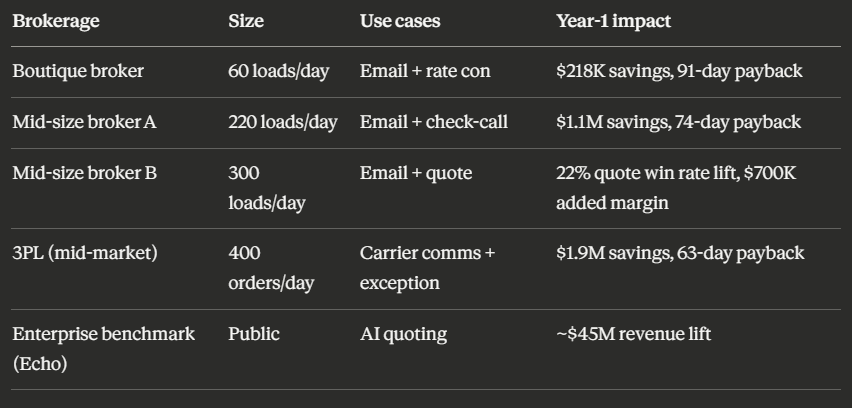
The pattern: revenue lift from faster quoting dominates for brokers under 300 loads/day; labor savings dominate above that.
The 2026 vendor landscape (tight version)
- Parade.ai — Strong at carrier capacity management and voice check-calls. Thinner on email and forwarder use cases. Best fit for brokers where capacity sourcing is the bottleneck. See: Parade alternative
- HappyRobot — Voice-first. Well-funded ($44M Series B). Limited email and document parsing. Best for brokers with heavy outbound call volume. See: HappyRobot alternative
- Raft.ai — Freight forwarder specialist with strong document automation. Weaker on brokerage-specific use cases. See: Raft alternative
- Augment (goaugment.com) — Operator copilot pattern — sits alongside the human rather than replacing routine work. Strong founder content, fewer reference customers than the category leaders. See: Augment alternative
- Wisor.ai — Revenue platform for forwarders. More analytics than agent. See: Wisor alternative
- Debales — Multi-agent platform covering email, quote, check-call, rate con, and exception. Bootstrapped to $1M ARR. TMS integrations with the six majors. Fastest time to first value in the category.
Every shortlist in 2026 should include 2–3 of these based on your primary use case. The wrong move is shortlisting on brand alone.
A realistic 90-day deployment plan
- Days 1–10: Email agent in sandbox. Connect TMS read-only. Train on last 30 days of inbox.
- Days 11–30: Email agent in production with human approval on every send. Target 40% auto-draft coverage.
- Days 31–60: Rate con parser live. Check-call agent in sandbox. Email agent at 70% coverage with writeback on green-light categories.
- Days 61–90: Check-call agent in production. Exception agent in sandbox. Email coverage at 85%+. Weekly audit replaces per-message review.
Skip any of these milestones and ROI slides by 30–40%. Hit all of them and the ROI calculator numbers become real.
FAQ
What is an AI agent for a freight broker? Software that autonomously handles carrier emails, quote requests, check-calls, rate confirmation parsing, and routine exceptions — including writing back to the TMS. It's different from a chatbot in that it takes action in the real world and maintains memory across interactions.
How is an AI agent different from a freight chatbot? Chatbots respond to single messages with text. Agents read full threads, act in external systems (TMS, email, calling platforms), maintain memory across loads and carriers, and measure their own outcomes.
What's the fastest AI agent use case to deploy? Rate confirmation parsing (3–5 business days) and email agent (5–10 business days). Full carrier communication automation with TMS writeback takes 3–6 weeks.
Will an AI agent replace dispatchers? In production deployments, no. Dispatchers are reassigned to carrier development, exception resolution, and new lane acquisition. The ROI works better that way because the reassigned hours generate new revenue.
Which TMS platforms integrate with AI agents today? McLeod LoadMaster, Alvys, Tai TMS, Turvo, Rose Rocket, and Descartes Aljex all have production integration patterns in 2026. Custom TMS platforms can integrate via API or direct database where permitted.
How much does an AI agent platform cost for a brokerage? Pricing is typically a flat platform fee ($2K–$8K per month for mid-market) plus per-load usage. Per-seat pricing exists but creates misaligned incentives.
What's the payback period on AI agents for brokers? 60 to 120 days for brokers that integrate into the TMS. 120 to 180 days for brokers running the agent as a parallel tool.
Is this the same as agentic AI or autonomous logistics? Yes. "Agentic AI" is the academic term; "AI agent" is the product term; "autonomous logistics" is the category term investors use. Same thing.
Ready to see the numbers on your brokerage? Run the ROI Calculator, then book a 20-minute tour and we'll replay the math against your actual load volume.
Sanjay Parihar is CEO at Debales AI, which builds AI agents for freight brokers, 3PLs, and forwarders. Bootstrapped to $1M ARR. Debales integrates with McLeod, Alvys, Tai TMS, Turvo, Rose Rocket, and Descartes Aljex.
All blog posts
View All →
Thursday, 30 Jul 2026
Hormuz, the Red Sea, and the Cape: When Every Shipment Becomes an Exception
The Strait of Hormuz is closed and Suez traffic is rerouting around the Cape. Why exception management — not tracking — is now the core logistics job, and how AI agents absorb the message surge.

