AI Agents: From Firefighting to Strategic Leadership in Logistics
Friday, 31 Oct 2025
|
Introduction: Transforming Reactive Logistics into Proactive Power
AI agents automate routine tasks like inventory tracking and exception alerts, freeing leaders from firefighting to pursue strategic initiatives that drive 25-35% revenue growth in logistics firms. This shift elevates organizations by enabling focus on high-value activities such as market expansion and innovation, reducing operational chaos that consumes 40% of executive time. By handling mundane workflows autonomously, AI agents turn data into foresight, empowering teams to lead rather than react.
For logistics executives, operations managers, and C-suite leaders, this evolution addresses the 60% of daily interruptions from routine issues, fostering a culture of strategic agility. This guide demonstrates automation's impact, key capabilities, implementation strategies, and real-world elevations to inspire organizational transformation. As AI matures, organizations leveraging it for leadership see 4x faster decision-making and sustained competitive edges.
The Burden of Routine Firefighting in Logistics
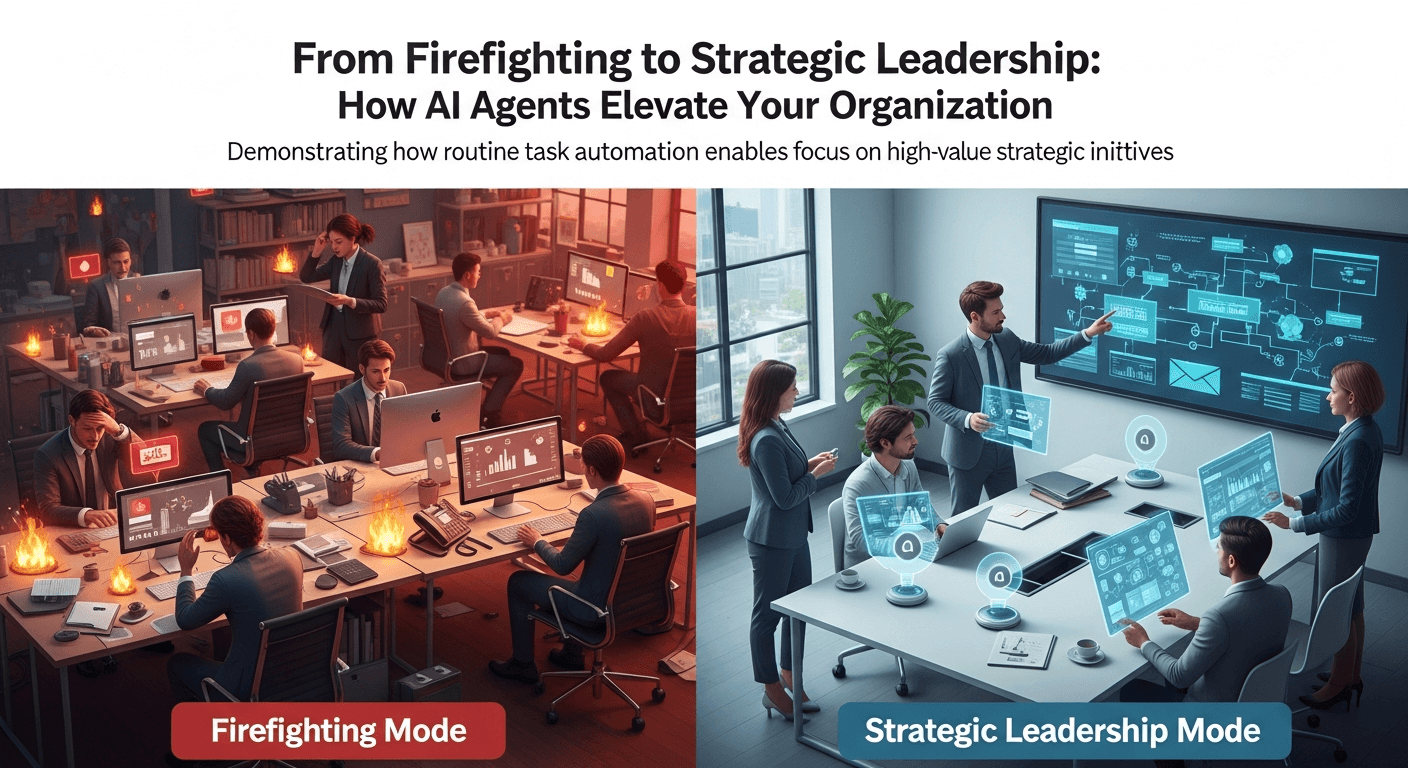
Daily operations in logistics involve constant firefighting—resolving delays, reconciling discrepancies, and chasing updates—that diverts 50% of managerial efforts from strategy. Manual processes like shipment tracking or compliance checks lead to errors costing 5-10% of annual budgets, trapping teams in reactive cycles. This mindset stifles innovation, with 70% of leaders reporting limited bandwidth for long-term planning amid escalating volumes.
Global complexities amplify these burdens, where email overload and siloed systems exacerbate delays, resulting in missed opportunities and eroded margins. Without automation, organizations remain vulnerable to disruptions, perpetuating a survival mode over strategic dominance. AI agents break this cycle by proactively managing routines, unlocking leadership potential.
How AI Agents Automate Routine Tasks
AI agents deploy as specialized software that monitors, decides, and executes tasks like predictive rerouting or anomaly detection without human input. Using machine learning, they process real-time data from TMS and IoT to automate 80% of repetitive alerts, slashing response times by 70%. Multi-agent systems collaborate— one for inventory, another for compliance—ensuring seamless coverage across operations.
Integration with existing platforms via APIs allows instant deployment, transforming firefighting hotspots like freight disputes into automated resolutions. This automation not only minimizes errors but provides audit trails for compliance, reducing regulatory risks by 40%. Leaders gain visibility dashboards summarizing actions, freeing cognitive resources for elevation.
Key Routine Tasks Handled by AI
- Inventory Reconciliation: Agents cross-check levels in real-time, preventing stockouts and overages that waste 15% of resources.
- Shipment Exception Management: Automatic notifications and rerouting resolve 90% of delays without escalation.
- Compliance and Documentation: AI extracts data from emails and forms, ensuring 99% accuracy in customs and audits.
- Vendor Communications: Automated follow-ups and queries cut email volume by 60%, streamlining procurement.
These capabilities eliminate drudgery, redirecting efforts to value creation.
Elevating to Strategic Leadership with Freed Capacity
With routines automated, executives focus on high-value initiatives like scenario planning and partnership development, boosting strategic output by 50%. AI-generated insights enable predictive strategies, such as optimizing networks for sustainability, yielding 20% cost savings. Leaders use agent reports to inform board-level decisions, aligning operations with growth visions.
This elevation fosters innovation, where teams explore AI expansions like digital twins for resilience, rather than daily fixes. Organizational culture shifts to proactive leadership, enhancing employee engagement by 30% through meaningful work. Ultimately, AI agents position firms as industry pioneers, capturing market share through foresight.
High-Value Initiatives Unlocked
Strategic network redesign leverages AI simulations to test expansions, reducing risks by 35%. Sustainability drives integrate emissions tracking for green certifications, meeting 80% of ESG mandates. Talent development programs upskill for leadership, turning operators into strategists. Market intelligence agents uncover trends, informing 25% more profitable ventures.
These pursuits elevate performance beyond efficiency to excellence.
Integration Strategies: Deploying AI for Elevation
Start with pilot agents on high-pain routines like last-mile tracking, scaling based on 20% time savings metrics. Cloud-based platforms ensure scalability, integrating with ERP for end-to-end automation. Change management involves training on oversight, not execution, to embrace the leadership shift.
API gateways connect agents to legacy systems, minimizing disruptions during rollout. Governance frameworks monitor agent performance, with human veto for strategic alignments. This structured approach realizes 90% automation coverage within a year.
Overcoming Implementation Barriers
Address resistance by showcasing quick wins, like 40% faster resolutions, to build buy-in. Data quality initiatives clean inputs for agent accuracy, avoiding 15% error pitfalls. Security protocols protect automated flows, complying with GDPR in global ops. Vendor partnerships accelerate setup, cutting deployment by 50%.
Proactive mitigation ensures smooth elevation.
Roadmap: Transitioning from Firefighting to Strategy
Phase 1 (Weeks 1-4): Identify routines via audits, deploying initial agents for monitoring. Phase 2 (Months 2-3): Automate core tasks, measuring freed time and reallocating to strategy sessions. Phase 3 (Months 4-6): Scale to full workflows, integrating insights for high-value projects.
Ongoing: Quarterly reviews refine agents, with leadership training sustaining gains. Budget 10-15% of ops spend, targeting 3x ROI in strategic value. Track progress with KPIs like strategic initiative launches.
ROI and Case Studies: Proven Organizational Elevations
AI automation delivers 300-450% ROI by reclaiming 30% leadership time for initiatives that grow revenues 18% annually. DHL automated routines with agents, shifting to strategic expansions that added $200M in new markets. FedEx used AI for exceptions, elevating to predictive planning that cut costs 22% and boosted innovation.
These transformations demonstrate elevation's tangible impact.
Explore More on Debales.ai
- Automating Logistics Workflows: ROI of Eliminating the USD2.8B Bottleneck
- Dynamic Freight Pricing Intelligence: AI Agents for Real-Time Profit
- Self-Healing Supply Chains: AI Systems for Real-Time Disruption Resolution
- Multi-Agent Orchestration: Autonomous Collaboration in Supply Chains
- The Human Side of Supply Chain Automation
Elevate Your Organization with AI Agents
Shift from firefighting to strategic leadership today. Engage Debales.ai for an automation audit and customized agent deployment.
Conclusion: Lead with AI-Driven Elevation
AI agents automate routine tasks, enabling organizations to transition from firefighting to strategic leadership focused on high-value initiatives that drive growth and resilience. This elevation unlocks untapped potential, positioning logistics firms for enduring success. Embrace AI agents to redefine your future.


