How Generative AI Will Add $7B to Logistics And Who Will Win
Tuesday, 10 Jun 2025
|
How Generative AI Will Add $7 B to Logistics — And Who Will Win
(Start Training AI Agents Today or Risk Falling Behind)
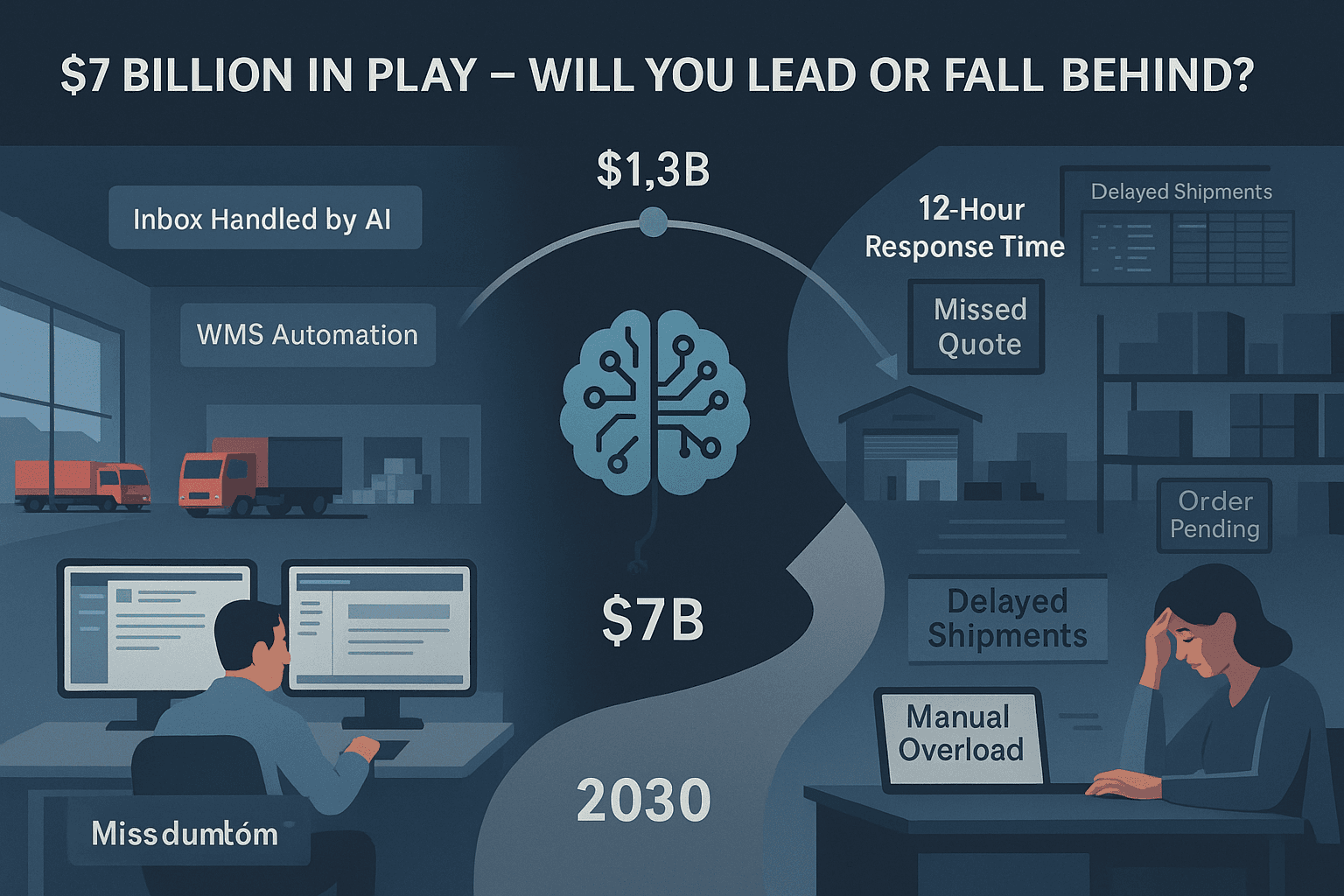
Generative AI in logistics was valued at $1.3 billion in 2024 and is projected to reach $7.0 billion by 2030, growing at a 32–33% annual rate globenewswire.com+1marketresearch.com+1. In the U.S. alone, 2024 spending topped $341 million, signifying a fast-moving shift in how supply chains operate .
This isn't a future forecast—it’s happening now. Companies that start training AI agents today in areas like email, support, routing, and orders will gain a clear advantage. The question is: who will lead—and who will get left behind?
Why the $7 B Surge Matters for U.S. Logistics
First, consider the speed of this adoption:
- The global market is growing at 32–34% CAGR, more than eight-folding in six years infosys.com.
- U.S. firms currently lead the charge—accounting for nearly 85% of global generative AI logistics spend in 2024 infosys.com.
This means companies that don’t integrate AI into their logistics operations—whether that's forklift routing, warehouse bots, or inbox agents—are at risk of falling behind competitively.
AI Use Cases Transforming Logistics Today
Generative AI is being deployed across four main areas:
Warehouse Fulfillment and Robotics
- Amazon’s Lab 126 is deploying agentic AI robots to perform multiple warehouse functions simultaneously, boosting efficiency and reducing costs snsinsider.com+15reuters.com+15docshipper.com+15.
- As we showed here, Amazon’s robots cut fulfillment costs by around 20–25%, a model any mid-size logistics operator can adapt through digital automation .
Predictive Operations and Asset Management
- Maersk saved $300 million through AI-driven predictive maintenance and routing. Smaller operators can replicate this success with WMS and fleet data docshipper.com+1timesofindia.indiatimes.com+1.
- Explore these lessons in: Maersk Saved $300M with AI — Lessons for 3PLs.
Smart Inbox Automation
- Replying faster is now table stakes. Inbox agents now handle 80–95% of logistics emails, reducing response times to under 3 minutes. Learn why inbox automation is now baseline.
- These systems improve support, quoting, and order confirmations across 3PLs and freight firms.
Customer Support Driven by AI
- Generative AI in support dramatically cuts interaction times and boosts customer satisfaction but only when integrated with routing and CRM systems.
- Learn more from how 2–3 minute replies are reshaping freight support and how bots handle 95% of interactions in logistics workflows: Manual Customer Support in Logistics Is Dead.
Who Is Winning—and Who Isn’t
Early Adopters Win
- Firms adding generative AI to logistical nodes—like routing, orders, and email—are taking market share fast.
- Those that don’t risk falling into a costly reactive posture.
Bigger isn’t always better
- Mid-sized 3PLs and warehouses can match enterprise efficiency with low-cost, high-value inbox automation instead of waiting to scale into robotics.
Integration is strategic
- The best results come when AI bots are part of an ecosystem—email, WMS, CRM, routing platforms.
- For example, automated order routing combined with high-speed email replies delivers compounding ROI for logistics teams. See how inbox + order AI works in: WMS Order AI Agent ROI.
What You Need to Do Right Now
Set AI goals by function — e.g., 90% inbox automation, predictive maintenance alerts, support SLA under 3 minutes.
Pilot an inbox AI agent in one key email stream—support or RFQs.
Track performance metrics—number handled, response time, ticket deflection, cost per ticket.
Expand into orders and operations—start with smart rerouting and predictive notifications.
Plan for robotics later, but start with digital and data.
Dig into best practices in inbox AI here:
The Bottom Line
Generative AI in logistics is no longer a niche technology—it’s a $7 billion growth opportunity that’s redefining efficiency. The moves you make today—whether inbox pilot or WMS integration—will determine whether you lead or lag.
If you're ready to build generative AI into your logistics workflows and capture your share of that $7B:
All blog posts
View All →
Tuesday, 29 Sep 2026
Golden Week and an Early End to Peak: What to Automate Before the Ocean Lull
Importers front-loaded ahead of Golden Week, making September the busiest import month at 2.31M TEU (NRF). The lull after October 7 is the window to automate ocean workflows before Q1.

