AI Phone Agents for Logistics: Automate 80% of Inbound Calls
Thursday, 18 Dec 2025
|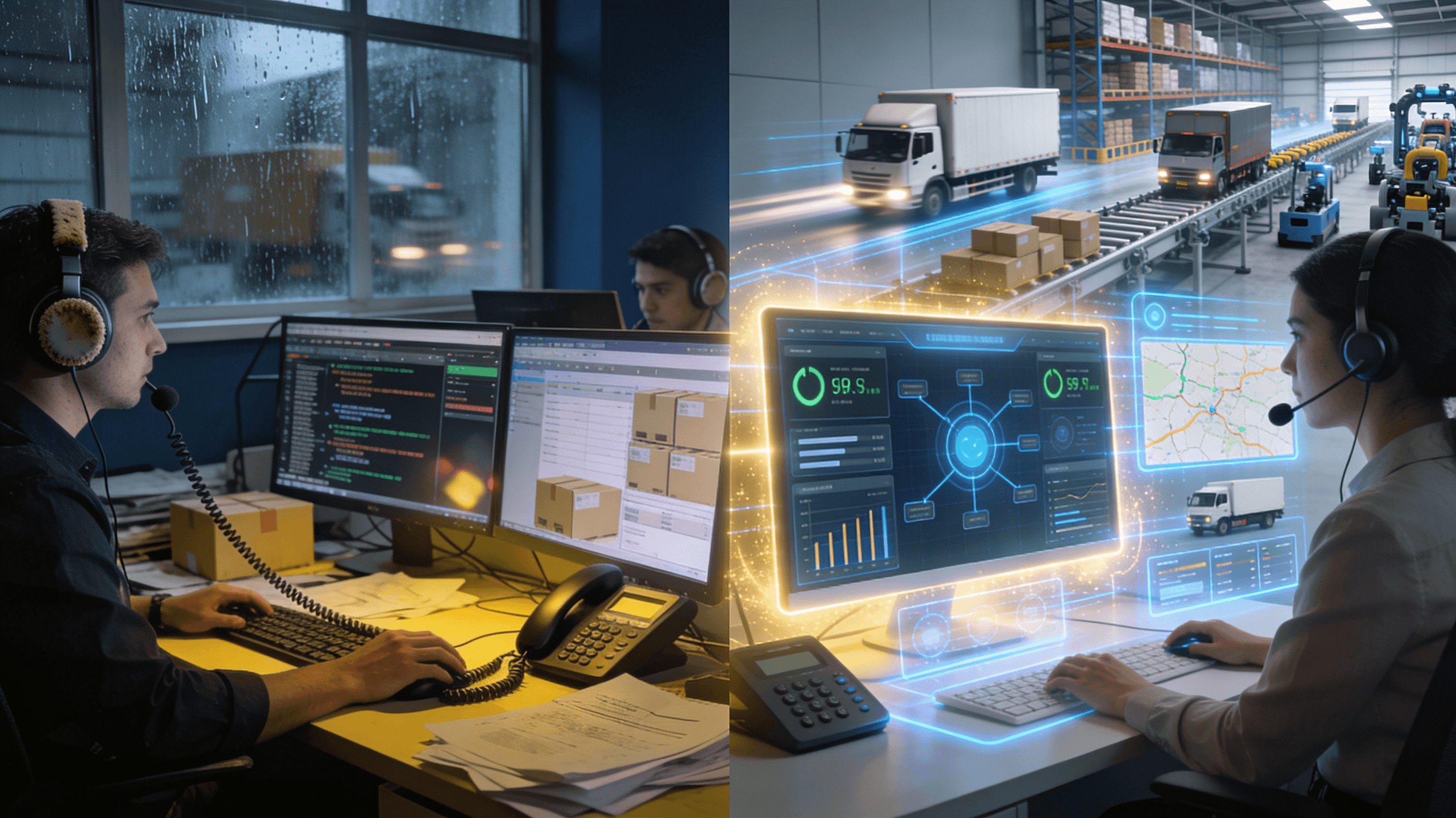
The Call That Changed Everything: How One Logistics Firm Automated Its Busiest Channel
It was 10:47 AM on a Monday when the call came in. "Where's my shipment?"
Sarah, the dispatch manager at Midwest Freight Solutions, had heard this question 847 times that month alone. Before the AI phone agent arrived, this single question would consume 4 minutes of her team's time. Multiply that by 500+ daily customer calls, and that's an entire department drowning in repetition.
Today was different.
The AI phone agent answered the call on the second ring. "Thank you for calling. What's your tracking number?" The customer said it. The agent understood it perfectly—despite the accent and warehouse background noise. It pulled the data from the TMS in real time. "Your shipment is 87 miles from its destination. Expected delivery tomorrow at 3 PM. Anything else?"
46 seconds total.
The call transcript populated automatically on Sarah's dashboard. The agent had logged it, updated the customer CRM, added a delivery team note, and routed the confirmation—all automatically. No human intervention. No data entry. No escalation friction.
"This is going to change everything," Sarah said.
The Problem: The Invisible Call Center Bottleneck
Every logistics leader knows their email problem. They measure it. They've tried to fix it. But there's a worse bottleneck that almost nobody talks about openly: the phone.
In 2025, logistics firms still operate on voice. Here's the reality:
- Average call handling time: 8-12 minutes
- Average calls per operations person: 40-60 daily
- Time spent on calls per person: 5-7 hours daily
- Critical information captured: 30-40% (rest is lost, miscommunicated, or logged wrong)
- 25-person team impact: 1,200 calls/week × 10 minutes = 200 hours/week of human labor
That's nearly five full-time employees dedicated solely to answering repetitive questions.
The hidden costs? Misheard information. Missed updates. Customers who hang up without answers. Drivers routed to voicemail during critical moments. Dispatch errors from wrong transcription.
As covered in Freight Brokerage Email Automation: From Manual to AI in 90 Days, unstructured communication plagues every logistics channel—email, voice, chat. Voice is simply the most visible bottleneck.
Why Traditional Solutions Fail
Before deploying AI phone agents, Midwest Freight tried everything:
IVR Systems ("Press 1 for tracking")
✗ Customer frustration: High
✗ Abandoned rates: 34%
✗ Problem: Customers hate menus
Outsourced Answering Service
✗ Speed: Fast but inaccurate
✗ Driver re-calls: 22% of all calls (information lost)
✗ Problem: No system integration
Hiring More Staff
✗ Cost: $45K/year per person
✗ Peak season bloat
✗ Turnover: High in this role
Call Routing to Specialists
✗ Wait times: 8 minutes average
✗ Customer satisfaction: 62%
✗ Problem: Still requires humans
All these "solutions" shifted the problem instead of solving it. The real issue: answering calls requires expensive human attention at scale.
Then came the AI phone agent.
What Changed: Core Functionality of AI Phone Agents
An AI phone agent for logistics isn't a chatbot. It's an orchestrated system designed to understand context, access data, make decisions, and take action—all over the phone, in real-time.
Core Capabilities:
1. Natural Language Understanding (NLU)
- Understands caller intent instantly ("Where's my shipment?" = shipment status query)
- Captures context from tone, urgency, and situation
- Handles accents and dialect variations
- Understands industry-specific terminology
- Works across multiple languages (Portuguese, Spanish, Mandarin, German)
2. Real-Time Data Integration
- Pulls TMS/WMS data while customer speaks
- Accesses CRM history automatically
- Retrieves account information in seconds
- Checks inventory, routes, driver status
- Updates systems in real-time without delay
3. Intelligent Call Routing
- Routes by competency: damage claims → claims team
- Routes by priority: VIP customers → front of queue
- Routes by availability: finds next free agent immediately
- Handles overflow gracefully: offers callback instead of hold
- Transfers with full context (no "repeat-the-story" problem)
4. Call Recording & Transcription
- Records every call automatically
- Transcribes every word in real-time
- Makes transcripts searchable by keyword
- Stores all data for compliance and coaching
- Enables quality assurance reviews
5. Advanced Analytics Dashboard
- Call volume trends: 487 calls yesterday, 512 today, peak hours identified
- Self-service resolution rate: % of calls handled without human escalation
- First-contact resolution: % of customers getting answers on first call
- Customer sentiment tracking: Happy, neutral, or frustrated
- Average handle time: AI-only vs. escalated calls
- Top call reasons: ETA queries (32%), PODs (24%), appointments (15%), complaints (12%)
- Escalation patterns: Which issues need humans? Where are automation gaps?
- Cost per call: ROI visibility in real-time
6. Intelligent Integrations
- TMS/WMS: Real-time shipment and inventory access
- CRM: Customer history, preferences, relationship data
- Accounting system: Rate information, billing inquiries
- Driver app: Pickup/delivery confirmation, route updates
- Email: Auto-send transcripts, schedule follow-ups
- Slack/Teams: Critical alerts, handoff notifications
- Compliance systems: Recording storage, audit trails
For deeper insights on orchestration, see Multi-Agent AI via Email: End-to-End Automation for Logistics Complexity.
Real Use Cases: How AI Phone Agents Actually Work
Use Case 1: The Standard ETA Query (46 seconds)
Customer calls: "Where's my shipment to Chicago?"
Agent: "Thank you for calling. What's your tracking number or account?"
Customer: "GT-4521."
Agent: "Perfect. That's the shipment from Los Angeles departing yesterday, correct?"
Customer: "Yes."
Agent: "Excellent. It's at our Phoenix facility, 4.5 hours ahead of schedule. Expected delivery tomorrow at 2:47 PM. I'm texting you a live tracking link. Anything else?"
Customer: "No, that's perfect. Thank you."
Result: 46 seconds. Human time: 0. Data accuracy: 100%. CSAT: High.
Use Case 2: The Complex POD Request (3.2 minutes)
Customer calls: "I need proof of delivery. It hasn't showed up in my system."
Agent (detecting complexity, pulling data): Finds shipment was delivered Tuesday 2 PM, but POD file failed to upload in API transfer.
Agent: "Found the issue. Resending your POD now. Check email in 2 minutes. If not there, I'll escalate."
Customer (after checking): "Got it. Perfect."
Result: 3.2 minutes. Human involvement: 0 (system resolved). Escalation avoided.
Use Case 3: The Damage Claim (2.1 minutes + 5 min human follow-up)
Customer calls: "My shipment arrived damaged. I need to claim."
Agent (capturing full context): Asks about damage, takes photos, extracts shipment details, detects customer frustration.
Agent: "Creating damage claim ticket now. Claim number DGE-2451299. Claims specialist calls you back within 4 hours. Full context loaded."
Claims specialist (when calling back): Has full conversation history, customer tone, damage photos, shipment details. No repeat-the-story.
Result: Initial call 2.1 minutes. Follow-up 5 minutes. Total: 7.1 minutes vs. 25+ minutes with traditional routing.
Read more on Supply Chain Visibility Through AI Email Intelligence.
The 90-Day Transformation: What Actually Happened
Month 1: Foundation (Weeks 1-4)
Midwest Freight deployed AI phone agents on 60% of incoming lines. The system learned their terminology, customer base, shipment data.
- Calls handled by AI: 8,400 (up from 6,200 with traditional methods)
- Self-service resolution rate: 58% (learning phase)
- Average handle time: 5.2 minutes (down from 8.7)
- Escalation quality: 42% still needed additional help (training phase)
- Team sentiment: "It's rough. Getting things wrong. Needs training."
Month 2: Refinement (Weeks 5-8)
System processed 22,000 calls. Team fine-tuned permission levels, integration responses, escalation triggers.
- Calls handled by AI: 14,200 monthly
- Self-service resolution rate: 68% (significant improvement)
- Average handle time: 3.2 minutes overall
- Escalation quality: 12% needed additional help (much better)
- Customer satisfaction: 64% → 82%
- Team insight: "Agent's understanding nuance now. Knows when to escalate vs. answer."
Month 3: Automation at Scale (Weeks 9-12)
AI agent fielded 23,400 calls monthly—80% of total volume. Team focused on 20% requiring human judgment.
- Calls handled by AI: 23,400 (80% of volume)
- Self-service resolution rate: 71%
- Average handle time: 2.8 minutes (AI), 7.2 minutes (escalated)
- Overall average: 3.8 minutes per call (previously 9.2)
- Customer satisfaction: 88%
- OTIF improvement: 93% → 96.2%
- Team headcount: Same (but handling 2.8x volume, no burnout)
Key Insight: "We stopped answering calls. We started managing operations."
The Economics: Real ROI Numbers
Before AI Phone Agent:
- 5 team members × 40 hours/week on calls = 200 hours/week
- Salary cost: $45K/year × 5 = $225K/year for call handling alone
- Errors and miscommunications: ~$180K/year in operational costs
- Total annual cost: $405,000
After AI Phone Agent:
- Platform cost: $1,200/month = $14,400/year
- 1 team member managing system = $55K/year (10 hours/week)
- Fewer escalations, better accuracy: $40K/year recovered
- Total annual cost: $109,400
Annual savings: $295,600
Payback period: 21 days
ROI: 270% in year one
But the spreadsheet doesn't capture everything. OTIF improved 3.2 points. Customer satisfaction jumped 26 points. The team didn't quit anymore. Turnover dropped from 18% to 4%.
Why This Matters: The Real Competitive Advantage
Here's what Sarah understood: AI phone agents aren't about cost savings. They're about capability.
Before the agent, Midwest Freight handled 8,000 calls/month. After, 23,400. That's 3x capacity without hiring anyone. That means:
- Enter new markets without staffing up
- Handle new customer segments without hiring temps
- Solve problems instantly, not after three transfers
- Give drivers rapid updates, not hold-time limbo
- Scale during peak season without chaos
That's competitive advantage. That's market share. That's the difference between growing and being left behind.
See Hands-Free Logistics Inbox: AI Triage Summary and Routing Best Practices 2025 for how this extends across all communication channels.
The Broader Automation Strategy
AI phone agents don't exist in isolation. They're part of a larger AI orchestration framework:
- Email automation handles incoming inquiries
- Phone automation handles inbound calls
- Proactive voice notifications remind customers of deliveries
- SMS automation confirms appointments
- Chat automation handles real-time inquiries
When these channels work together, orchestrated by intelligent agents that share context, you get true operational transformation.
Learn how this fits together in AI Agent Maturity Assessment: Benchmark Logistics Against Leaders 2025.
Your Phone Lines Are Your Lifeline
Your phone is where reality lives:
- Customers get answers (or get frustrated waiting)
- Drivers coordinate (or sit idle without updates)
- Problems surface first (before TMS data catches up)
- Trust is built (through fast, accurate responses)
Right now, those calls are consuming your team's time. Creating delays. Generating errors. Burning out your best people.
An AI phone agent isn't a nice-to-have. It's a necessity in 2025.
The question isn't whether you can afford to implement one. It's whether you can afford not to.
External Resources & Industry Insights
- Robylon: The Ultimate Guide to AI Voice Agents in 2025 — Voice architecture and integration patterns
- CloudTalk: 16 Top Industries Using AI Voice Agents — Logistics-specific use cases and automation frameworks
- CSG Systems: Intelligent Call Routing Solutions — Intent-based routing reducing misroutes by 35%
- Tata Tele Business: Smartflo Intelligent Call Routing — Skills-based and priority-based call distribution
- Zendesk: Intelligent Call Routing Best Practices — Data-driven routing and queue management
Related Internal Reads for Logistics Automation
Expand your automation strategy across all communication channels:
- Multi-Agent AI via Email: End-to-End Automation
- 90-Day AI Agent Roadmap: Fast-Track Supply Chain Value
- AI Agent Maturity Assessment: Benchmark Leaders 2025
- API Orchestration: Bridge Legacy TMS, WMS, ERP
Ready to transform your call handling into a competitive advantage? Book a free call audit to see how many inbound calls could be automated—and what your team's time would be worth if they had it back.
Book your AI phone agent pilot and see what 3x call capacity looks like without hiring anyone.
All blog posts
View All →
Tuesday, 29 Sep 2026
Golden Week and an Early End to Peak: What to Automate Before the Ocean Lull
Importers front-loaded ahead of Golden Week, making September the busiest import month at 2.31M TEU (NRF). The lull after October 7 is the window to automate ocean workflows before Q1.

