The Autonomous Freight Marketplace: AI Agents Streamline Load Matching
Friday, 18 Jul 2025
|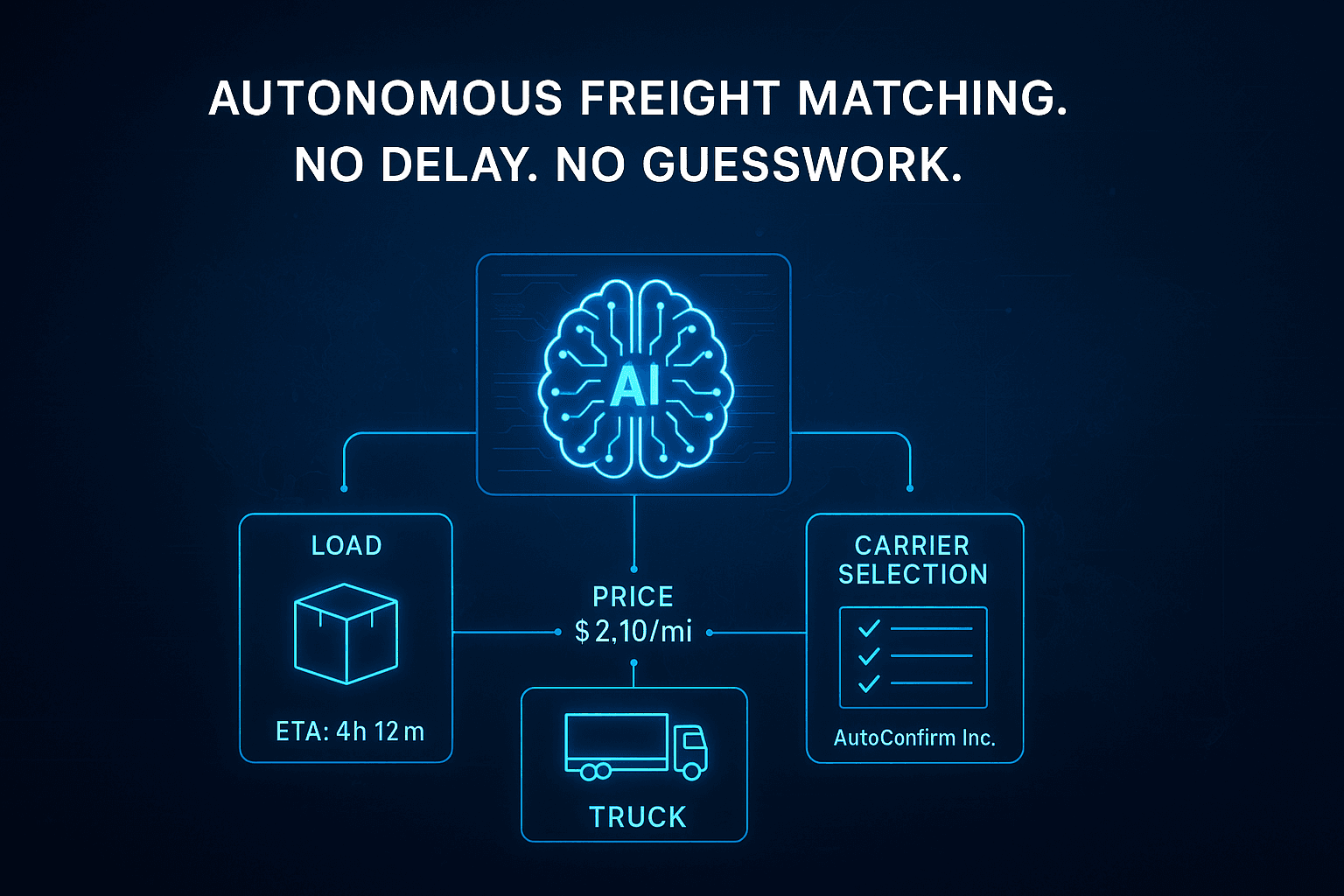
How AI Agents are Streamlining Load Matching and Carrier Selection
Imagine a freight market that matches loads and carriers instantly, without human intervention.
This isn't a futuristic fantasy—it's already happening. AI Agents are transforming freight brokerage by automating what once took hours or days: matching the right load to the right carrier with maximum speed, efficiency, and precision.
From Manual Matchmaking to Machine Precision
In traditional freight brokerage, matching loads with carriers involves countless emails, phone calls, rate confirmations, and human negotiation. It's time-consuming and often error-prone.
AI Agents eliminate these inefficiencies by handling:
- Carrier Selection: Evaluating thousands of carriers across variables like cost, available capacity, geographic proximity, on-time performance, and compliance history.
- Load Tendering: Instantly dispatching load offers to optimal carriers via their preferred digital channels (email, EDI, API, or portals).
- Smart Bidding: Learning from past wins/losses to optimize which carriers to approach first and at what price point.
- Digital Contracts: Auto-generating digital rate confirmations, contracts, and even follow-up paperwork—all without human input.
How It Works: AI Agents in Action
Let’s say a shipper posts a time-sensitive load from Dallas to Atlanta.
The AI Agent instantly checks internal carrier databases, real-time load boards, and partner APIs.
It filters carriers based on equipment type, lane history, and real-time capacity.
A top match is found—a reefer carrier currently 80 miles away finishing a nearby delivery.
Load tender is automatically sent with pricing, ETA, and contract.
Carrier confirms via API. Load matched.
Total time? Under 60 seconds.
Real Results from Autonomous Load Matching
Freight brokerages using AI Agents have reported:
- 40-60% reduction in manual load board postings
- 3x faster average load confirmation time
- 15-20% increase in carrier acceptance rates
- Dramatically lower fall-off rates and administrative burden
The Shift to Autonomous Marketplaces
AI Agents don’t just speed up existing processes—they unlock new business models:
- Always-On Marketplace: No wait times. Loads and trucks matched 24/7.
- Self-Optimizing Networks: Agents learn over time which carriers perform best on which lanes.
- Transparent, Scalable Operations: One broker can manage 10x the volume with automation.
This is not about replacing people. It’s about elevating them—letting humans focus on strategic, high-value tasks while AI handles the rest.
Book a Session: AI Agents for Freight Brokerage
Debales AI Agents are already powering next-gen load matching engines for modern freight companies.
👉 Book a session now to see how you can build your own autonomous freight marketplace.
Related Reading
- AI Freight Brokers: The New Frontier in Load Matching
- TMS vs AI Agents: Why the Future is Autonomous
- From Hours to Seconds: AI in Freight Quote Automation
The Future of Freight Isn’t Just Digital. It’s Autonomous.
AI Agents are redefining what it means to be a freight broker. Fast, intelligent, scalable. Your marketplace doesn’t need more humans to grow.
It needs more agents.


