Beyond HS Codes: AI Agents for Accurate Tariff Classification
Wednesday, 6 Aug 2025
|
Hidden tariff misclassification errors could be draining your profits without you even realizing it. One wrong HS (Harmonized System) code doesn’t just mean a minor paperwork issue—it can trigger costly fines, shipment delays, and even customs seizures. For many importers, freight forwarders, and 3PLs, this silent problem is a constant threat lurking in the background of every shipment.
While most businesses still rely on manual checks or basic document automation, these methods are nowhere near precise enough to avoid the complexity of modern global trade regulations. It’s time to move beyond the limits of traditional compliance tools and embrace AI-powered HS code classification as a competitive edge.
The High Cost of HS Code Errors
Incorrect tariff classification can have consequences far beyond a small duty overpayment.
- Direct Financial Losses – Misclassifications often mean paying duties at the wrong rate, which can quickly accumulate over multiple shipments.
- Regulatory Risk – Customs authorities worldwide are increasingly auditing import data. If your classifications are wrong, you risk back-dated penalties.
- Operational Delays – A flagged shipment can stall in customs for days—or even weeks—while reclassification takes place.
When compliance mistakes happen in high-volume operations like freight forwarding or 4PL orchestration, the impact on both profits and customer trust can be devastating.
Why Manual & Basic Automation Fail
Even with skilled customs brokers, human error is inevitable—especially when handling thousands of product SKUs across multiple countries. The same product can have different HS codes depending on slight variations in material composition, country of origin, or end use.
Basic automation tools help with document parsing, but they’re not built for the nuances of global tariff schedules. Without AI-level analysis, these systems miss subtle discrepancies that can trigger costly compliance issues.
AI Agents: Precision at Scale
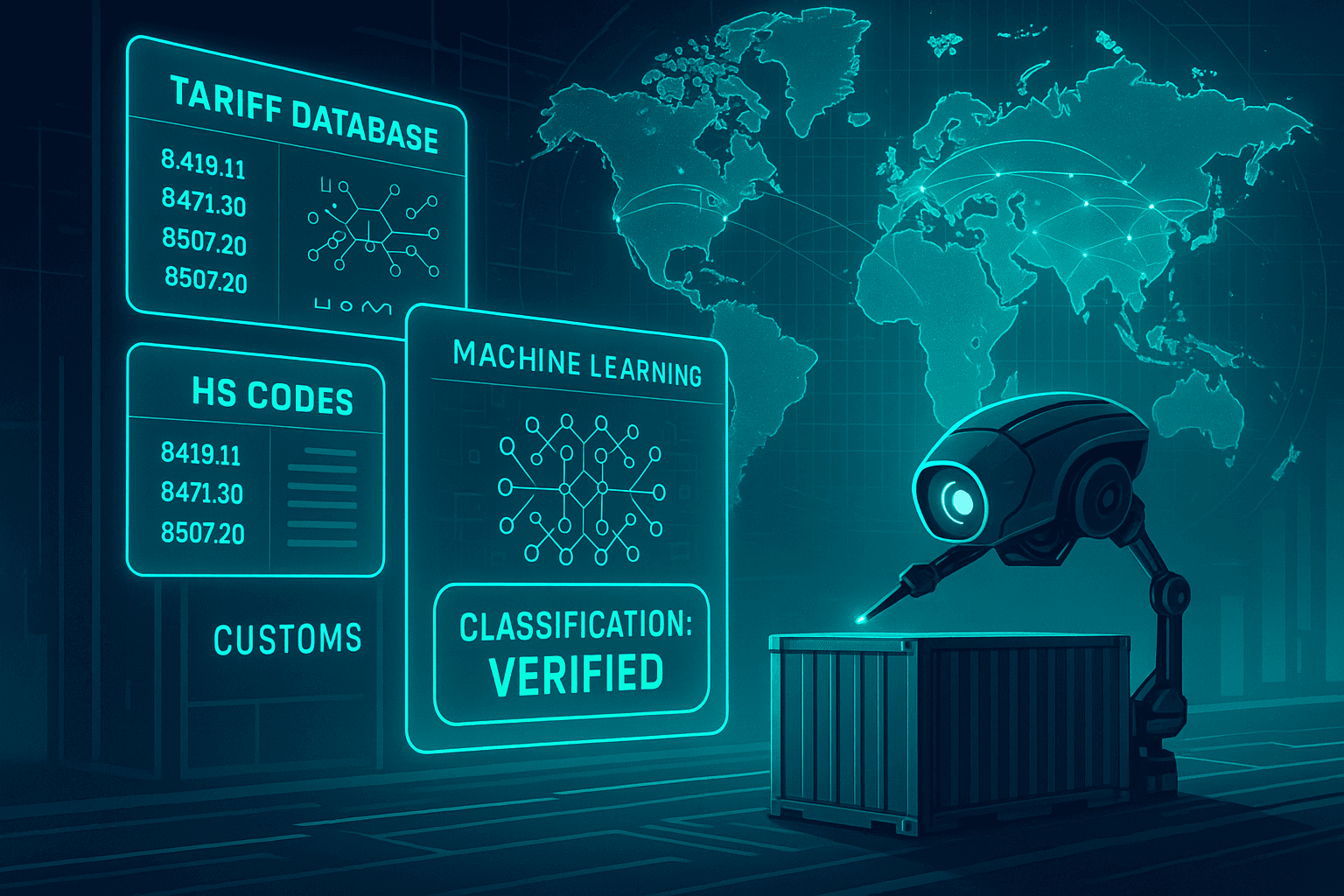
Machine learning-powered AI agents trained on historical customs records, product attributes, and multi-country tariff databases can achieve near-perfect HS code classification accuracy.
Here’s how they outperform traditional methods:
- Contextual Understanding – AI agents read full product descriptions, material data, and regulatory notes to determine the correct classification.
- Cross-Border Intelligence – They can instantly compare classification rules for multiple countries, avoiding errors in international shipments.
- Continuous Learning – Every customs clearance adds new examples, making the system smarter over time.
- Fraud & Risk Detection – Paired with AI customs fraud prevention systems, they can flag suspicious or intentionally misleading declarations.
For importers handling high-value or sensitive shipments, this precision is the difference between seamless clearance and costly disruptions.
The Operational Ripple Effect
When your HS codes are accurate from the start, the benefits go beyond compliance:
- Faster Customs Clearance – Reduced inspections and holds mean smoother supply chain flow.
- Lower Compliance Costs – Less need for manual rechecks or post-clearance corrections.
- Improved Customer Experience – Shipments arrive on time, building trust and loyalty.
These improvements pair perfectly with broader AI-driven logistics automation—from self-optimizing warehouses to real-time inventory management—creating a fully intelligent supply chain.
Beyond Compliance: Strategic Advantage
AI agents don’t just protect you from fines—they can be profit drivers. By automating HS classification, your team can focus on strategic operations like freight cost optimization, warehouse automation, and shipment fraud prevention.
In a global trade environment where regulations evolve constantly, staying compliant is no longer enough—you need to be faster, more accurate, and more resilient than your competitors.
Stop letting misclassification errors drain your profits.
Book a demo with Debales AI and see how our customs-trained AI agents can eliminate HS code errors, protect your margins, and accelerate your clearance process.
All blog posts
View All →
Monday, 13 Jul 2026
Cold-Chain Exceptions Can't Wait: Automated Alerts That Save the Load
In cold-chain logistics, a slow response to a temperature excursion means a ruined load. Here's why manual exception handling fails cold chain — and how AI agents catch and communicate exceptions in time to act.

Monday, 13 Jul 2026
The 2 a.m. Quote Request: Winning Freight While Competitors Sleep
A huge share of freight quote requests arrive outside business hours — and go cold before anyone replies. Here's what after-hours demand costs brokers and how 24/7 AI quoting captures it.

Friday, 10 Jul 2026
Consolidation Is Back in Freight. Here's How Lean Teams Compete.
With the freight recession over and M&A returning in 2026, bigger, better-capitalized competitors are consolidating the market. Here's how lean logistics teams scale volume without scaling headcount.