AI Agent vs. Live Chat: The ROI & Cost Breakdown for Shopify
Saturday, 5 Jul 2025
|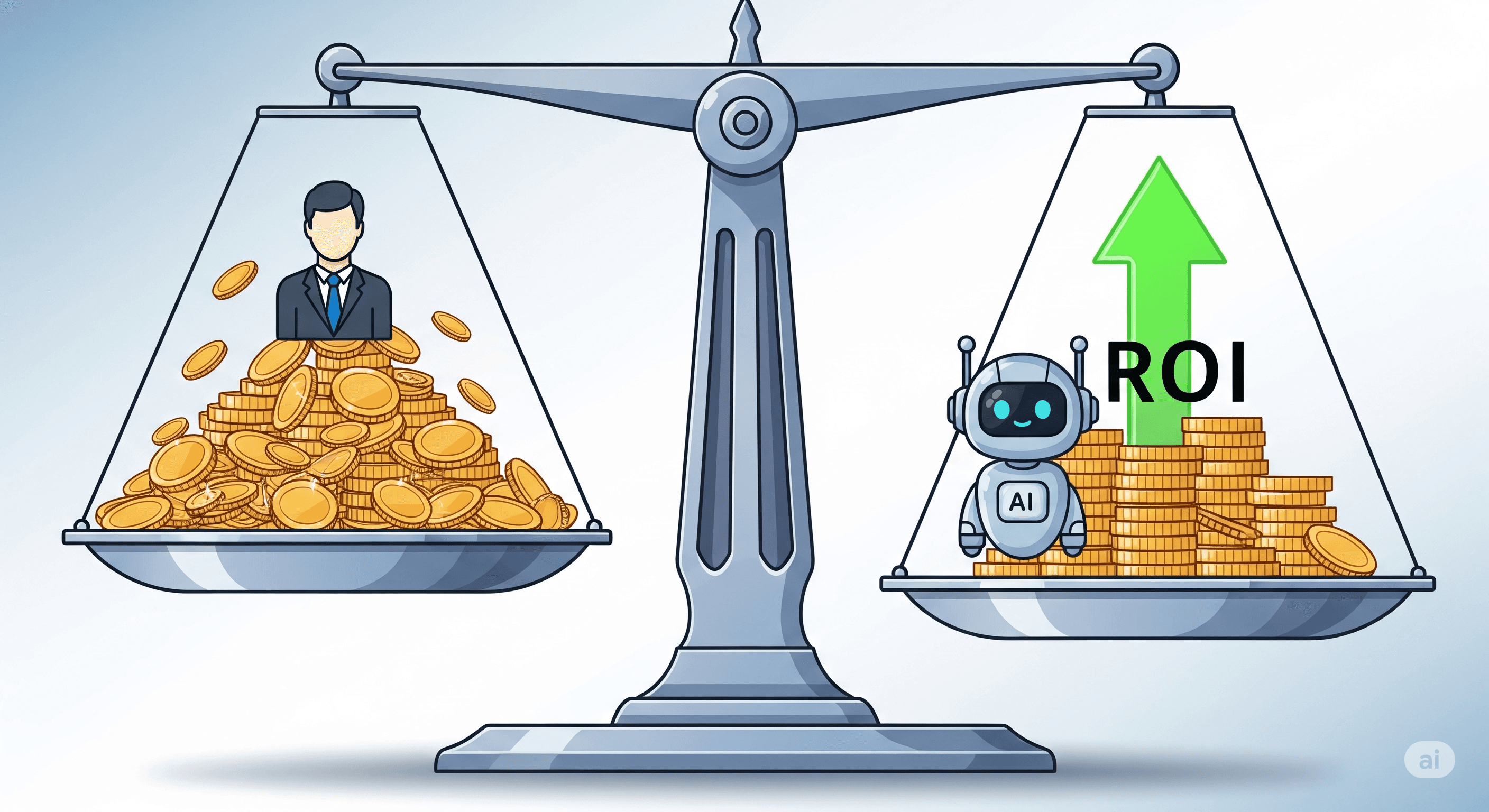
A single human support agent costs your business approximately $6 per minute of interaction. A sophisticated AI sales agent costs less than 25 cents per minute and can simultaneously increase your conversion rate by $21\%. For stores serious about profitable growth, the choice isn't just about technology—it's about mathematics.
As a Shopify merchant focused on scaling, every dollar counts. You analyze ad spend, cost of goods, and shipping margins with precision. But one of the biggest line items—customer interaction—is often overlooked. The decision between hiring live chat agents and deploying an AI sales agent is one of the most critical financial choices you'll make.
Let's break down the numbers and move beyond anecdotes to a clear, data-driven cost-benefit analysis.
The Unavoidable Mathematics of Customer Interaction
First, let's establish the financial baseline. While hiring a human agent feels like adding a personal touch, it comes with significant, recurring, and often unpredictable costs.
- Cost Per Interaction: A live human agent costs between $3.00 - $6.50 per minute of engagement. An AI Sales Agent like Debales costs between $0.03 - $0.25 per minute.
- Annual Cost: The fully-loaded cost of a single, full-time human support agent can easily exceed $110,000 per year (including salary, benefits, training, and software). An AI agent is a predictable, low monthly SaaS fee.
When you look at the raw numbers, the cost efficiency is not even a close contest. But the financial argument goes much deeper than just cost savings.
Beyond Cost: The Operational Advantages of AI
Putting the direct cost savings aside, the operational differences are stark. A human agent is limited by time and capacity; they work an 8-hour shift and can typically handle only one or two conversations at a time. An AI Sales Agent operates 24/7/365 and can scale to handle a virtually unlimited number of simultaneous conversations without any drop in performance. This ensures no customer is ever left waiting, whether it's a holiday or the middle of your busiest sales event.
Furthermore, an AI agent breaks down global barriers instantly. While a human team is limited by the languages they speak, an AI can communicate fluently with customers from around the world in their native tongue. It also automatically collects and structures data from every interaction, providing you with actionable insights—a task that is manual and often inconsistent for human-led teams.
The Hybrid Model: Optimizing, Not Eliminating
The goal isn't necessarily to eliminate human interaction entirely. The most intelligent, modern strategy is a hybrid model where technology and people are deployed for their highest and best use.
- The AI Sales Agent handles $80\% of interactions: answering common questions, guiding users to products, recovering abandoned carts, and processing upsells. It manages the high volume of automatable tasks instantly and at a low cost.
- The Human Agent is reserved for the remaining $20\%: handling complex, high-touch, or emotionally charged scenarios where empathy and nuanced problem-solving are most valuable.
This model frees your valuable human team from repetitive tasks, allowing them to focus on VIP customers and complex issues that truly drive brand loyalty.
The Critical Difference: Cost Center vs. Revenue Generator
This is the most important distinction for a growth-focused store.
A human agent is predominantly a cost center. Their primary role is to provide a service and solve problems, which is essential but is fundamentally an operational expense.
An AI Sales Agent like Debales is a revenue generator. Its core programming is not just to answer questions, but to actively increase top-line revenue through measurable actions:
- Conversion Rate Boost: Lifts conversions by up to $21\%.
- AOV Increase: Raises Average Order Value by up to $41\%.
- Cart Recovery: Recovers up to $29\% of abandoned carts.
While your human agent is costing you $6 a minute to explain your return policy, your AI agent is costing pennies to generate thousands of dollars in new and recovered sales.
The ROI-Driven Decision for Scalable Growth
When you analyze the data, the conclusion is logical and unavoidable. For any Shopify store that aims to scale profitably, an AI Sales Agent is not a discretionary expense or a luxury item. It is a financial and strategic necessity.
It reduces operational costs, enhances customer experience, and—most critically—directly contributes to revenue growth with a demonstrably positive ROI. The math speaks for itself.
Ready to calculate the specific ROI for your store?
👉 Book a Personalized Demo to Analyze Your Cost-Savings & Revenue Potential
Want to see the financial impact firsthand?
👉 Install Debales from the Shopify App Store and Start Your Free Trial
All blog posts
View All →
Wednesday, 2 Sep 2026
Agentic AI in Freight: What Actually Changes in 2027
Gartner projects agentic supply chain software spend reaching $53 billion by 2030 and 40% of enterprise applications embedding agents by the end of 2026. Here's what that means concretely for a broker next year.

