Why Logistics Still Runs on Email — And How AI Fixes It Fast
Monday, 2 Jun 2025
|
Why Do Logistics Companies Still Rely on Email?
(And How to Fix It Before It Costs You)
If you're running a 3PL, freight brokerage, or warehouse operation—especially in hubs like Chicago, Los Angeles, Dallas, or Newark—you know one thing:
Everything still runs through email.
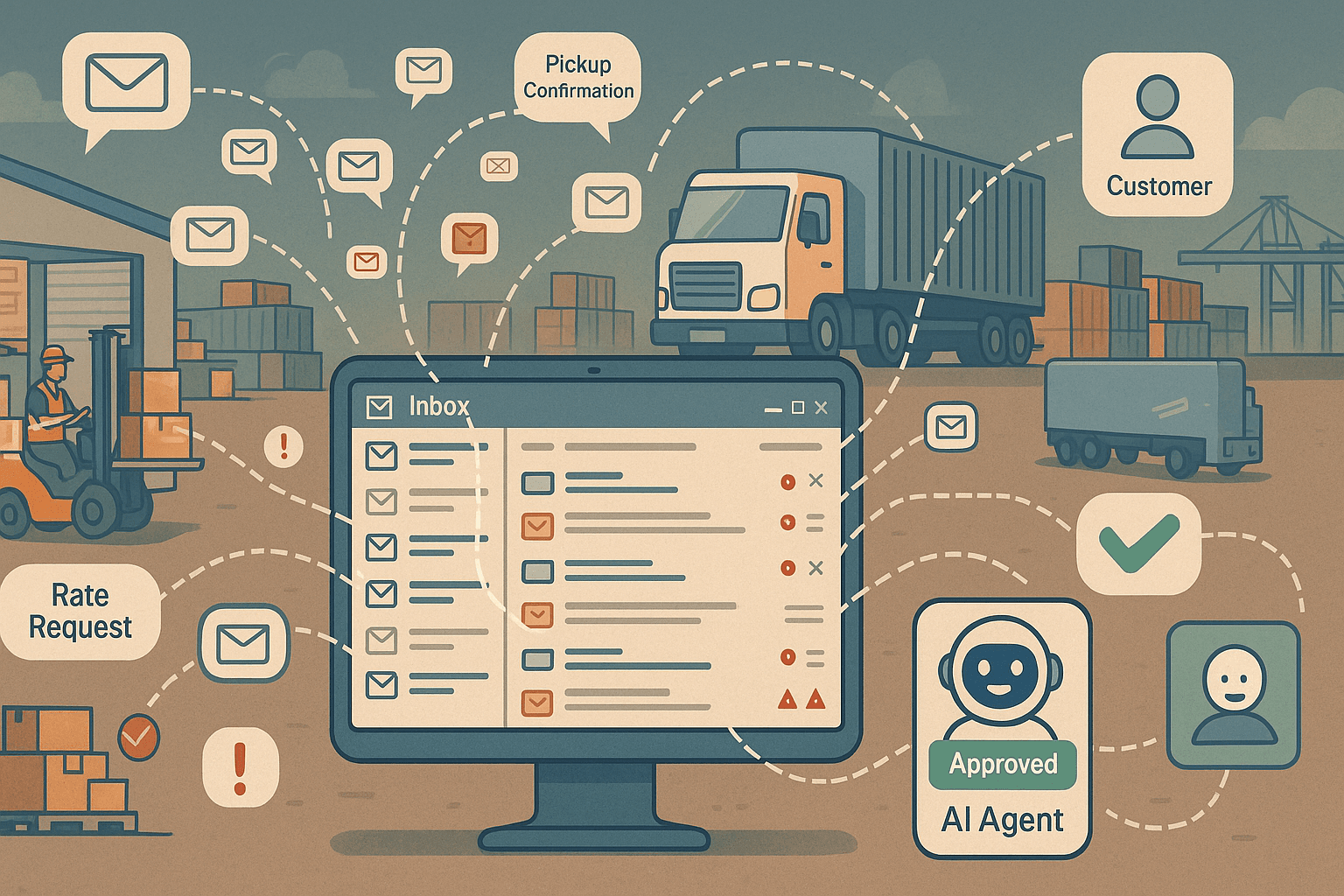
Pickup confirmations, rate requests, customs documents, load tenders—all of it passes through inboxes. Outlook threads are the de facto TMS for thousands of logistics firms.
But this dependence comes at a cost: delays, missed revenue, and errors.
Let’s break down why logistics still leans on email, what goes wrong, and how AI-powered email agents are now saving teams 5–6 figures a month.
Why Email Still Runs Logistics Operations
Here’s the simple answer: email is the only tool everyone in the supply chain already uses.
- You don’t need training to use email
- It works across borders, time zones, and tech stacks
- It handles files, replies, and records—all in one place
- Most brokers and carriers still don't have direct API integrations with each other
That’s why, even in advanced logistics operations, the heartbeat is still:
“Did you see that email?”
For a breakdown of how email shapes modern 3PL and logistics workflows, see AI Email Agents for Logistics and 3PL.
What Happens When Email Breaks Down in Freight Operations?
When one email is missed, delayed, or buried under 300 other threads, the chain reaction starts:
- Missed pickups or dock appointments
- Late customs filing or incorrect HS codes
- Quote delays that cost you the shipment
- Detention and demurrage charges
- Angry clients who churn without warning
We covered the exact cost impact of this in AI Customer Support Savings in 3PL Email Workflows.
For high-volume logistics hubs like the Port of LA or DFW, the damage from poor email management can exceed $30,000/month.
Why Manual Email Management Fails at Scale
Here’s the problem: inboxes don’t scale.
As your shipment volume grows, so does your email load.
Operations managers and support teams start firefighting—searching for the last quote, forwarding attachments, and manually tracking response times.
That’s not sustainable for:
- Freight forwarders handling 100+ emails a day
- Warehousing teams getting PODs and BOLs from multiple carriers
- Support agents dealing with WMS-generated notifications and customer inquiries
If this sounds familiar, you're not alone. Email AI Agent for Customer Support explains how logistics firms are solving this with AI that learns your email workflows.
How AI Agents Fix the Email Problem in Logistics
With AI-powered email agents, you no longer need humans to handle the repetitive, high-volume inbox work. The AI scans incoming emails, identifies the intent (rate request, BOL, complaint, etc.), and takes action:
- Sends back an instant, relevant reply
- Extracts data from PDFs or Excel files
- Assigns or escalates messages to the right team
- Updates a CRM, TMS, or WMS based on content
Think of it as your smart inbox assistant, built specifically for 3PL and freight workflows.
Companies using Order AI Agents with WMS systems have reported higher accuracy and faster order processing—without hiring more staff.
Real Examples: Email AI Agents in U.S. Logistics Firms
- A Miami-based freight forwarder reduced quote response time from 6 hours to under 30 minutes
- A Chicago 3PL eliminated 85% of email-related SLA misses
- A Dallas fulfillment center saw a 60% drop in duplicated emails and ticket escalations
- A California warehouse slashed their average support email time by 90%
Want to See How It Works for Your Logistics Business?
Email isn't going away—but manual email handling should.
If you're a logistics operator, 3PL manager, or shipping CXO tired of losing time and money to email chaos, it’s time to test Debales AI in your workflow.
See how our platform can:
- Cut support and operations email volume by 70–90%
- Improve quote response speed and customer satisfaction
- Integrate with your WMS, Outlook, Gmail, or custom tools
- Track KPIs like response time, missed inquiries, and email types
Book your free AI Email Agent demo now and see what streamlined inboxes look like in freight.
All blog posts
View All →
Tuesday, 29 Sep 2026
Golden Week and an Early End to Peak: What to Automate Before the Ocean Lull
Importers front-loaded ahead of Golden Week, making September the busiest import month at 2.31M TEU (NRF). The lull after October 7 is the window to automate ocean workflows before Q1.

