Mess-O-Meter: 7 Ways to Measure Chaos for AI Success
Monday, 10 Nov 2025
|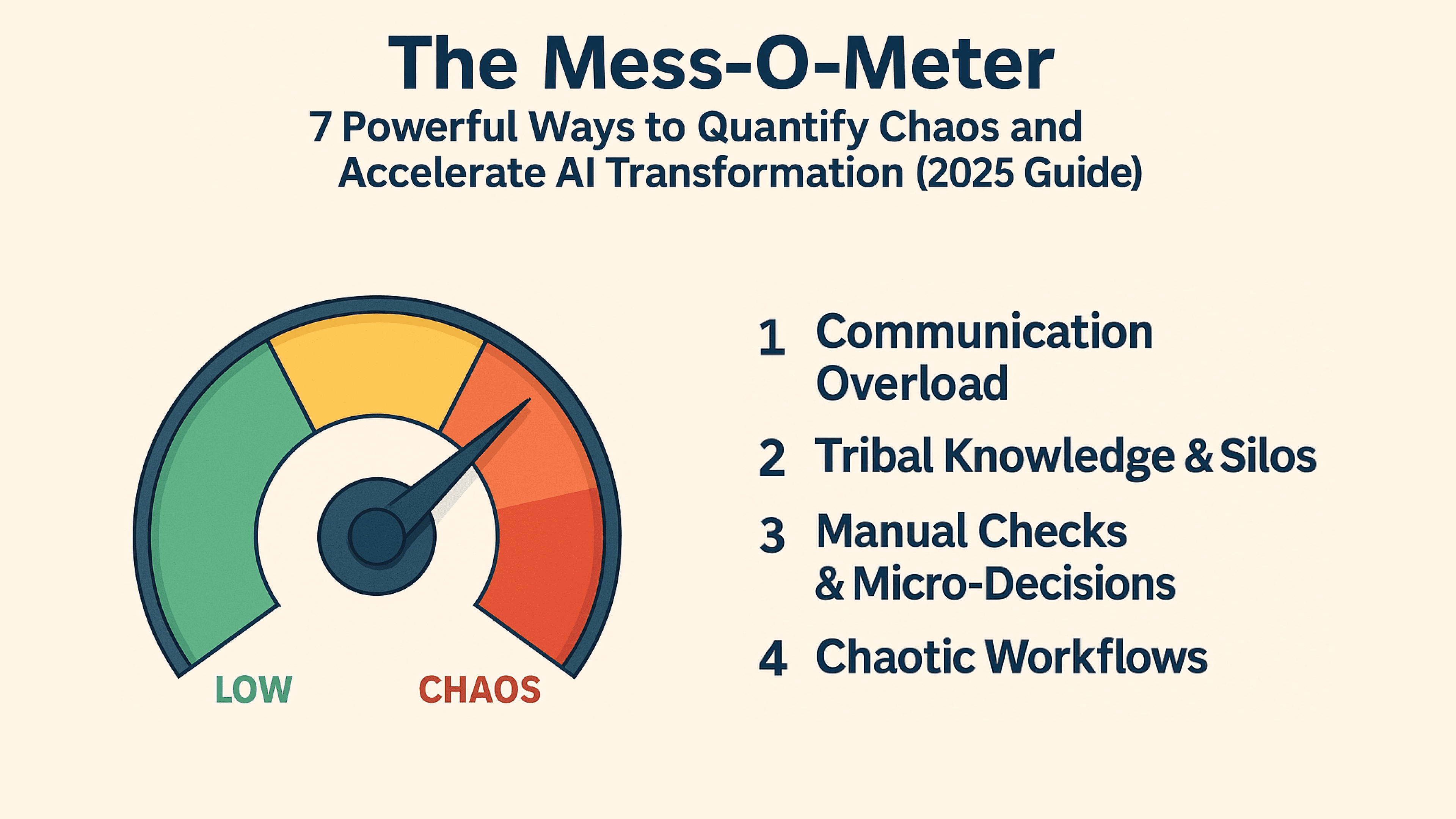
The Mess-O-Meter: 7 Powerful Ways to Quantify Chaos and Accelerate AI Transformation (2025 Guide)
Introduction to the Mess-O-Meter
Every organization wants to implement AI. But very few know where to apply it. The biggest mistake companies make is jumping straight into automation without first understanding the chaos hiding inside their workflows. That’s where the Mess-O-Meter comes in — a diagnostic framework that quantifies the “Human Mess” slowing down decision-making, collaboration, and operational execution.
In a world where processes run faster than people can manage them, the Mess-O-Meter provides something priceless: clarity.
What Is the Mess-O-Meter?
The Mess-O-Meter is a structured metric that measures hidden inefficiencies created by human communication, inconsistent workflows, and manual processes. Instead of guessing where AI may help, it quantifies:
- Workflow disorder
- Communication friction
- Decision-making delays
- Manual micro-tasks
- Tribal knowledge risk
Organizations use this score to identify where automation will deliver the highest impact with the lowest resistance.
Understanding the “Human Mess”
The Human Mess represents all the chaotic, unstructured, people-dependent work that creates bottlenecks.
1. Communication Overload
Workflows buried in emails, chats, pings, meetings, and forwarded threads.
Result: Slow decisions, lost information, operational drag.
2. Tribal Knowledge & Silos
Critical processes live inside people’s heads rather than systems.
Result: Risk exposure, inconsistent quality, zero scalability.
3. Manual Checks & Micro-Decisions
Teams perform tiny decisions all day long — approvals, updates, calculations, validations.
Result: Unseen labor cost + high error rate.
4. Chaotic Workflows
No standardization. No repeatability. Everything depends on who’s available.
Result: Operational fragility.
Why the Mess-O-Meter Matters in 2025
AI is no longer the bottleneck — your workflows are.
Studies show that most AI initiatives fail because the underlying processes are unpredictable, undocumented, or overly dependent on humans. The Mess-O-Meter exposes these conditions before AI investment begins.
How the Mess-O-Meter Enables Smart Prioritization
The Mess-O-Meter feeds directly into a three-part decisioning model:
Human Mess Score – How painful the workflow is
Impact Score – What value a reimagined process delivers
Complexity Score – Difficulty of implementation
This allows organizations to prioritize AI automation with scientific precision.
Connecting the Mess-O-Meter to Gartner’s AI Maturity Model
Gartner describes AI maturity across levels from Unaware → Opportunistic → Systematic → Transformational.
The Mess-O-Meter reveals why most organizations remain stuck at Level 2:
- Fragmented workflows
- Ad hoc decision-making
- Siloed communication
- No standard operating procedures
By targeting high-mess areas with AI agents, companies accelerate into Level 4 — creating autonomous, predictable workflows.
How AI Eliminates the Human Mess
AI isn't magic — it's a force multiplier for structured processes.
When you eliminate unnecessary communication, standardize workflows, and automate micro-decisions, something powerful happens:
💡 Humans shift from firefighting to strategic work.
AI becomes the engine that turns chaos into capacity.
Using Debales.ai with the Mess-O-Meter
Debales.ai can ingest your workflow data, identify the Human Mess, and deploy AI agents to automate the most chaotic segments.
Capabilities include:
- Workflow diagnostics
- Intelligent agent deployment
- Predictive decision-making
- Real-time documentation
- Process orchestration
It’s the perfect partner for organizations beginning their AI maturity journey.
See your Mess-O-Meter in minutes.
FAQs About the Mess-O-Meter
Q1: What is the Mess-O-Meter used for?
It measures hidden workflow chaos so organizations can prioritize AI automation effectively.
Q2: Is the Mess-O-Meter only for logistics?
No — it works across supply chain, finance, operations, customer service, HR, and more.
Q3: How often should we measure the Mess-O-Meter score?
Most companies reassess quarterly or after major workflow changes.
Q4: Can AI fix chaos on its own?
Not at all. AI amplifies whatever environment it enters — messy or clean.
Q5: Does the Mess-O-Meter replace process mapping?
No — it enhances it by revealing problems hidden inside communication channels.
Q6: What’s the fastest way to reduce Human Mess?
Start with automating micro-decisions and documentation via AI agents.
Conclusion
The Mess-O-Meter is more than a metric — it’s a roadmap. By surfacing the chaos slowing your teams down, it shows precisely where automation will drive the greatest ROI. When paired with tools like Debales.ai and aligned with Gartner’s maturity model, it becomes a gateway to operational clarity and AI-driven transformation.
All blog posts
View All →
Tuesday, 29 Sep 2026
Golden Week and an Early End to Peak: What to Automate Before the Ocean Lull
Importers front-loaded ahead of Golden Week, making September the busiest import month at 2.31M TEU (NRF). The lull after October 7 is the window to automate ocean workflows before Q1.

