The $2.8B Logistics Email Problem: Why Shared Inboxes Aren't Enough
Saturday, 9 Aug 2025
|
Why Every Logistics Email Solution Misses the Mark (And How to Fix It)
The logistics industry spends $2.8 billion annually on email-related inefficiencies. Yet most "solutions" only organize the chaos instead of eliminating it.
The Shared Inbox Trap: Why Current Solutions Fall Short
Sedna promises smart email routing for £75 per user monthly. Front offers collaboration features starting at $59 per agent. Levity provides email classification from $299 monthly.
But here's what they all miss: logistics teams don't need better email organization—they need email elimination.
The Real Problem: Manual Processing Bottlenecks
Even with the best shared inbox tools, logistics professionals still manually:
- Read and interpret each RFQ (20-30 minutes per quote)
- Search pricing databases and rate tables
- Calculate quotes using external systems
- Draft responses and attach documents
- Follow up on pending requests
This is where Debales.ai fundamentally differs from the competition.
How Debales.ai Solves What Others Can't
While competitors focus on email collaboration, Debales.ai eliminates the need for human intervention entirely:
1. Intelligent Document Processing
- Extracts structured data from messy PDFs, forwarded emails, and handwritten requests
- Competitors: Require manual data entry after email is routed
2. Real-Time System Integration
- Directly queries TMS, pricing databases, and rate engines via API
- Competitors: Email stays in inbox; requires separate system access
3. Complete Quote Generation
- Creates formal quotes with pricing, terms, and ETAs automatically
- Competitors: Flag emails as "needs response" but provide no automation
4. Autonomous Response
- Sends replies, attachments, and CCs appropriate team members
- Competitors: Draft responses still require human review and sending
Why Logistics-Specific AI Matters
Generic email automation tools miss critical logistics nuances:
- LTL vs. FTL pricing models
- Hazmat handling requirements
- Cross-border compliance considerations
- Carrier capacity constraints
- Seasonal rate fluctuations
Debales.ai is trained specifically on logistics workflows, understanding freight terminology, pricing structures, and operational constraints that general AI tools simply can't process.
The Competitive Advantage: Speed to Revenue
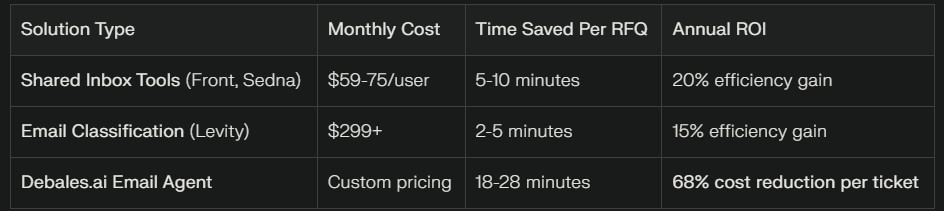
While your competitors spend hours organizing emails with shared inbox tools, your team closes deals in minutes with autonomous quote generation.
In logistics, speed wins business. Debales.ai doesn't just organize your email chaos—it eliminates it entirely.
Ready to move beyond email management to email mastery? Book a demo to see how autonomous quote generation transforms your logistics operation from cost center to profit driver.
Book a demo
All blog posts
View All →
Wednesday, 2 Sep 2026
Agentic AI in Freight: What Actually Changes in 2027
Gartner projects agentic supply chain software spend reaching $53 billion by 2030 and 40% of enterprise applications embedding agents by the end of 2026. Here's what that means concretely for a broker next year.

Tuesday, 1 Sep 2026
The Parcel-to-LTL Break-Even Moved. Does Your Quoting Logic Know?
USPS cut its DIM divisor in July, peak surcharges are up as much as 23%, and NMFC reclassification changed LTL pricing. The crossover point between parcel and LTL shifted on both sides at once.

Monday, 31 Aug 2026
Detention Is a Communication Failure With a Dollar Sign Attached
Detention costs the industry $15.1 billion a year and drivers are held at 39.3% of stops. Almost none of it is caused by a dock genuinely running out of capacity. It's caused by nobody telling anybody.