The Art of the Hand-off: Building a Seamless Human-AI Customer Service Workflow
Sunday, 3 Aug 2025
|
In customer service, few things frustrate a customer more than this scenario:
They spend five minutes explaining their problem to an AI chatbot—only to repeat the entire story to a human agent when the bot can’t resolve it.
It’s not just an inconvenience—it’s a trust-breaker.
The solution isn’t choosing AI or human agents, but designing a hybrid workflow where both work in harmony, ensuring a seamless hand-off that feels natural, fast, and frustration-free.
Why the Hand-off Is the Critical Moment
Your AI can answer FAQs, track orders, process returns, and even upsell. But there will always be queries that require human empathy, judgment, or exception handling.
If the transition from AI to human isn’t smooth, you lose all the efficiency and goodwill the AI just created.
This is why Debales AI’s Co-Pilot Model focuses on context continuity—making sure the human agent knows exactly what’s already happened before they join the conversation (see how our co-pilot works).
Best Practices for a Seamless AI-to-Human Hand-off
1. Capture Complete Context
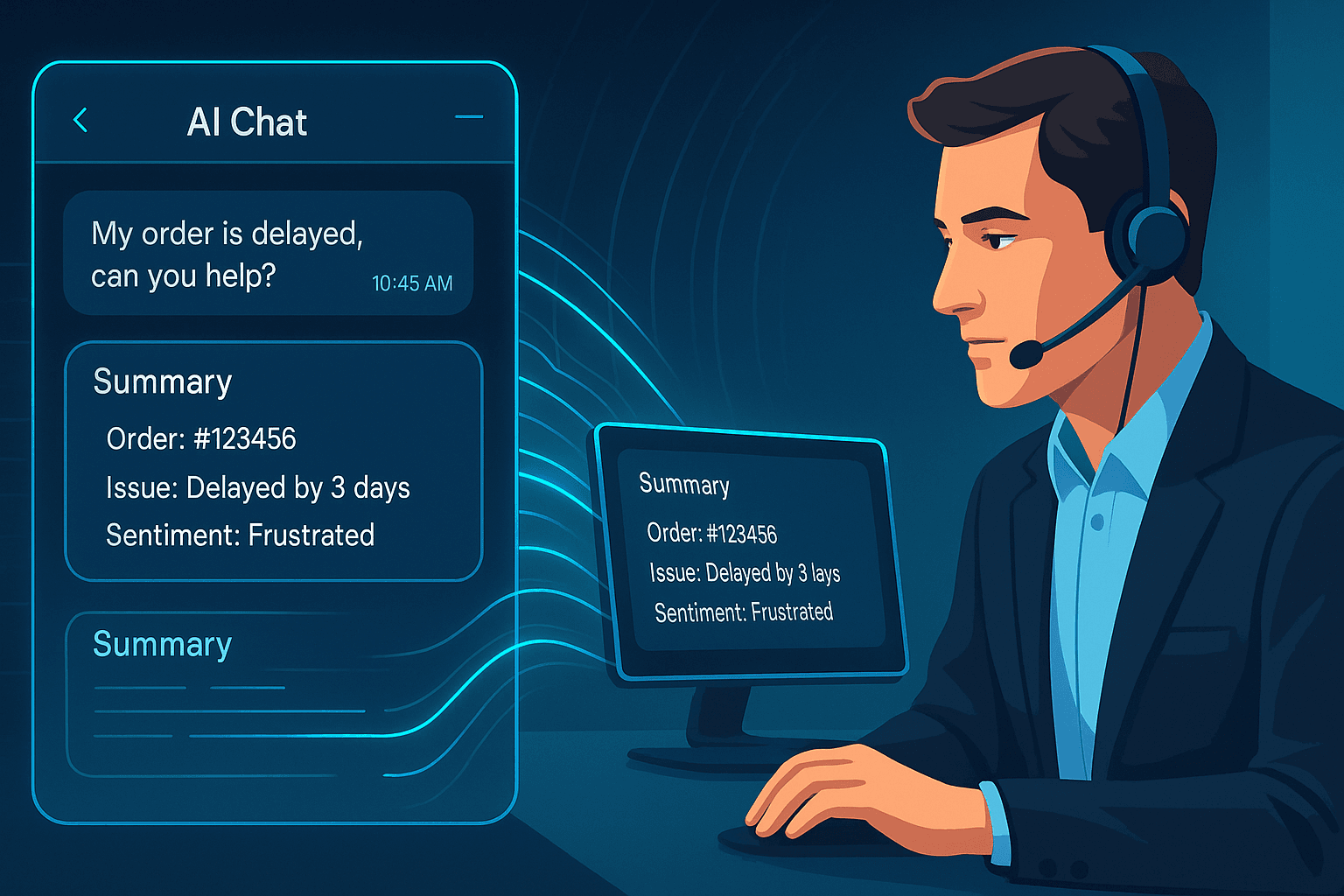
When AI detects that a conversation needs escalation, it should:
- Summarize the customer’s issue in a clear, structured format.
- Attach all relevant data—order IDs, past messages, related tickets.
- Include sentiment analysis so the human knows the emotional tone.
Example: Instead of “Customer needs help with order,” the agent sees:
“Customer: Order #12345 delayed by 5 days, tracking shows stuck at port. Tone: frustrated. Past orders: 6. Loyalty tier: Gold.”
2. Use a Shared Workspace
AI and human agents should work from the same interface so hand-off data is instantly visible—no switching tools or retyping notes.
3. Signal the Handoff to the Customer
Transparency builds trust. Let customers know a human is joining, and that they have the full context.
- “I’m connecting you with Alex, who has all the details of your order and delay.”
This reassures the customer they won’t have to repeat themselves.
4. Empower Humans with AI Insights
The AI shouldn’t disappear after escalation. It should stay in co-pilot mode, suggesting responses, pulling relevant knowledge base articles, and tracking resolution KPIs.
This mirrors the concept of AI collaboration in workforce empowerment explored in SupplyChainBrain—where AI serves as a partner, not a replacement.
5. Measure the Hand-off Experience
Track metrics that reveal hand-off quality:
- Percentage of customers who had to repeat information
- Resolution time after escalation
- CSAT scores specifically for escalated cases
This “orchestration” of roles reflects the Symphony of Human-AI Collaboration discussed in the SAP Community—where timing and harmony matter as much as individual skill.
From Frustration to Flow
The hybrid model works when the AI is more than a gatekeeper—it’s a true co-pilot, teeing up the human agent to succeed without wasting the customer’s time.
When implemented correctly:
- Customers feel heard—even if the AI couldn’t solve their issue.
- Agents feel prepared—no cold starts.
- Support teams work faster—because context isn’t lost.
Book a demo today to see how Debales AI’s hybrid model creates hand-offs so smooth, your customers won’t even notice the switch.
👉 https://debales.ai/book-demo
───────────────────────────
The best AI hand-off is the one your customer never notices. Debales AI agents handle 80-95% of logistics emails autonomously and escalate the rest with full context — so your team picks up where the AI left off, seamlessly. Book a 15-min demo →
All blog posts
View All →
Tuesday, 29 Sep 2026
Golden Week and an Early End to Peak: What to Automate Before the Ocean Lull
Importers front-loaded ahead of Golden Week, making September the busiest import month at 2.31M TEU (NRF). The lull after October 7 is the window to automate ocean workflows before Q1.

